Display Aircraft
DISPLAY AIRCRAFT
Last update: 10-6-25 at 11:47 AM CT
In addition to the amazing US Air Force Thunderbirds, you will see some of the best civilian and military pilots in the world – flying for you. Plus, one of the largest displays of civilian & military aircraft in North America (75+ planes).
Important Note on the Warbird Display Ramp
Some aircraft below are on the WARBIRD DISPLAY RAMP. Display times will vary. If you’d like to see these aircraft … please arrive early!
Please note: Aircraft below might not be the exact paint scheme shown. All display aircraft are subject to change without notice. Please check back the week of the show for the most up-to-date list of 2025 aircraft. Updates will be made as aircraft are confirmed. We will update this page throughout the summer. Keep an eye out for more details.
Please note: All displays and participating aircraft are subject to change due to operational requirements, national weather conflicts etc.
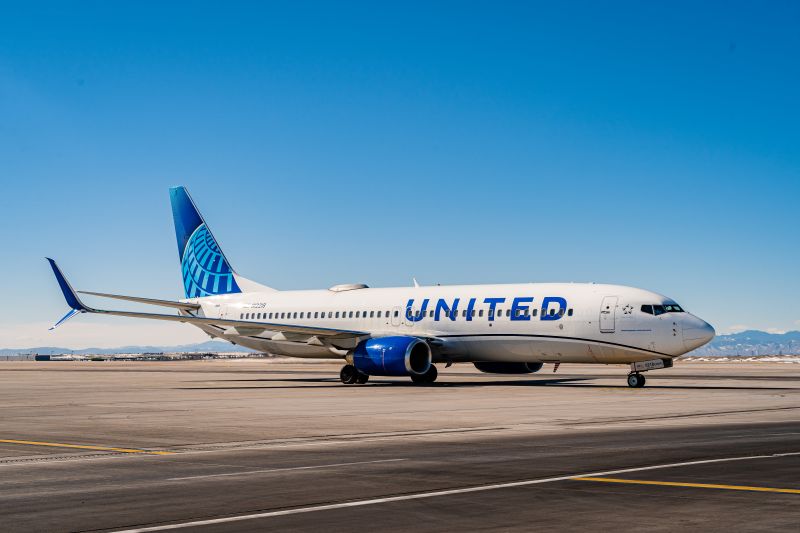
United Airlines Boeing 737
www.united.com/en/us/fly/company/aircraft/uniteds-fleet.html
United’s Boeing 737: Reliable. Efficient. Designed for You.
The Boeing 737 is the core of United’s fleet, flying across the U.S., Latin America, and
Canada. With more than 480 aircraft in service, it powers our United Next strategy –
making travel more efficient, sustainable, and comfortable.
• Sustainability: 737 MAX aircraft cut fuel use by up to 20%, lowering emissions and
noise as we work toward net-zero by 2050.
• Passenger Comfort: Boeing Sky Interior features LED lighting, larger carry-on bins,
quieter cabins, and smoother rides.
• Innovation Ahead: Coming soon – seatback screens with Bluetooth, power at every
seat, bigger bins for every passenger, and new Braille labels for improved
accessibility.
For United, the 737 isn’t just an airplane – it’s a commitment of reliability, efficiency, and
a better travel experience for every passenger.

NASA Gulfstream GV
www.nasa.gov/specials/jsc-aircraft-ops/gulfstream-gv.html
The Johnson Space Center (JSC) procured a long-range Gulfstream GV aircraft as part of a shared usage agreement between the International Space Station (ISS) Program and the NASA Earth Sciences Division (ESD). The ISS Program will use this aircraft to fulfill the Soyuz Direct and Commercial Crew Program Crew Return missions, and ESD will use this aircraft to support airborne science missions in remote locations around the world. The collaboration between the ISS Program and ESD replicates the successful shared usage model currently implemented by JSC on the Gulfstream GIII aircraft and provides the agency a business jet to serve as a true long range platform to execute missions around the world.
The aircraft was procured by the agency in September 2016. JSC modified the aircraft over the following winter to provide the necessary medical care to deconditioned astronauts and started executing the direct return mission in February 2017. The JSC engineering and maintenance teams have been completing the designs, analyses, and modifications required to transform the airplane into an airborne science platform. JSC is nearing the completion of these modifications as the installation of two, large nadir windows in the fuselage is slated to be completed in January 2019.
Image from: https://www.nasa.gov/image-article/nasa-gulfstream-jets-fly-over-downtown-houston/
NASA T-38 Talon
en.wikipedia.org/wiki/Northrop_T-38_Talon
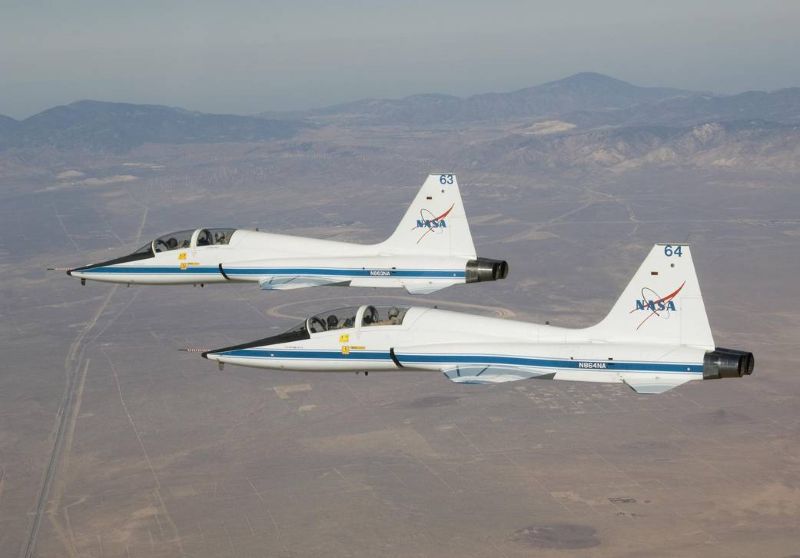
The Northrop T-38 Talon is a two-seat, twinjet supersonic jet trainer designed and produced by the American aircraft manufacturer Northrop Corporation. It was the world’s first supersonic trainer as well as the most produced.
The USAF is the largest operator of the T-38. Additional operators of the T-38 include NASA and the United States Navy. U.S. Naval Test Pilot School in Patuxent River, Maryland, is the principal US Navy operator. Other T-38s were previously used by the US Navy for dissimilar air combat training until replaced by the similar Northrop F-5 Tiger II. Pilots of other NATO nations have commonly flown the T-38 during joint training programs with American pilots. The T-38 remains in service as of 2025 with several air forces. As of 2025, the T-38 has been in service for over 60 years with the USAF, its original operator.
NASA WB-57
airbornescience.nasa.gov/aircraft/WB-57_-_JSC
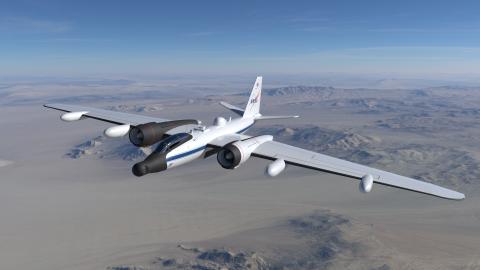
The NASA Johnson Space Center (JSC) in Houston, Texas is the home of the NASA WB-57 High Altitude Research Program. Three fully operational WB-57 aircraft are based near JSC at Ellington Field. The aircraft have been flying research missions since the early 1970’s, and continue to be an asset to the scientific community with professional, reliable, customer-oriented service designed to meet all scientific objectives.
The WB-57 is a mid-wing, long-range aircraft capable of operation for extended periods of time from sea level to altitudes in excess of 60,000 feet. Two crew members are positioned at separate tandem stations in the forward section of the fuselage. The pilot station contains all the essential equipment for flying the aircraft while the sensor equipment operator (SEO) station contains both navigational equipment and controls for the operation of the payloads that are located throughout the aircraft. The WB-57 can fly for approximately 6.5 hours, has a range of approximately 2500 miles, and can carry up to 8,800 lbs of payload. Note: The Airborne Science Program has provided partial funding to support the annual fixed costs of operating the WB-57F aircraft. Within this limited scope, subsidized flight hour rates are available to science mission customers. Contact Airborne Science and WB-57F program management for details.

B-29 Superfortress "FIFI"
commemorativeairforce.org/aircraft/10
FIFI was acquired by the CAF in the early 1970s when a group of CAF members found her at the U.S. Navy Proving Ground at China Lake, California where she was being used as a missile target. The airplane was rescued and restored and flew for over thirty years until 2006 when the chief pilot made the decision to ground her pending a complete power plant re-fit. What followed was an extensive four year restoration that included replacing all four engines with new custom built hybrid engines. FIFI returned to the sky in 2010 and since that time has traveled coast to coast attracting large crowds at every tour stop.
Info from the Commemorative Air Force
Photo by: Centerline Images
B-29 "Doc" Superfortress
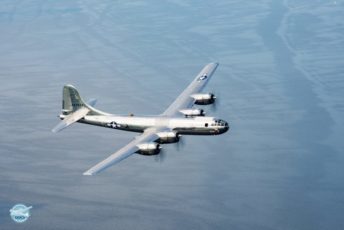
One of only two remaining flying B-29’s in the world!
Doc is a B-29 Superfortress and one of 1,644 manufactured in Wichita during World War II. Since 1987 when Tony Mazzolini found Doc on sitting and rotting away in the Mojave Desert, plans have been in the works to restore the historic warbird to flying status to serve as a flying museum.
Over the past 15+ years, hundreds of volunteers have worked on Doc and the restoration project. Skilled workers and retirees from Wichita’s aviation industry, veterans, active duty military and others wanting to honor those who served, have spent tens of thousands of hours on Doc’s restoration. Countless individuals and organizations also made financial and in-kind contributions to keep the project going.

CAF West Texas Wing SB2C Helldiver
The Helldiver’s performance has been maligned by many critics, frequently without regard to the facts. Some comparisons to other Navy aircraft are enlightening. The SB2C-4 had a higher cruising speed and greater range (without drop tanks) than the TBM Avenger, and a significantly higher top speed. It easily outperformed the SBD Dauntless in every category except range. Its cruising speed was only two mph slower than the F6F Hellcat. Only the F4U Corsair, among contemporary carrier-based aircraft, had a significantly superior speed. The Corsair could carry the same load as the Helldiver but over a much shorter range. Of aircraft designed in the same, immediate pre-war period, only the Corsair outlasted it in front-line Navy service.
A-26 "Night Mission"
commemorativeairforce.org/aircraft/14
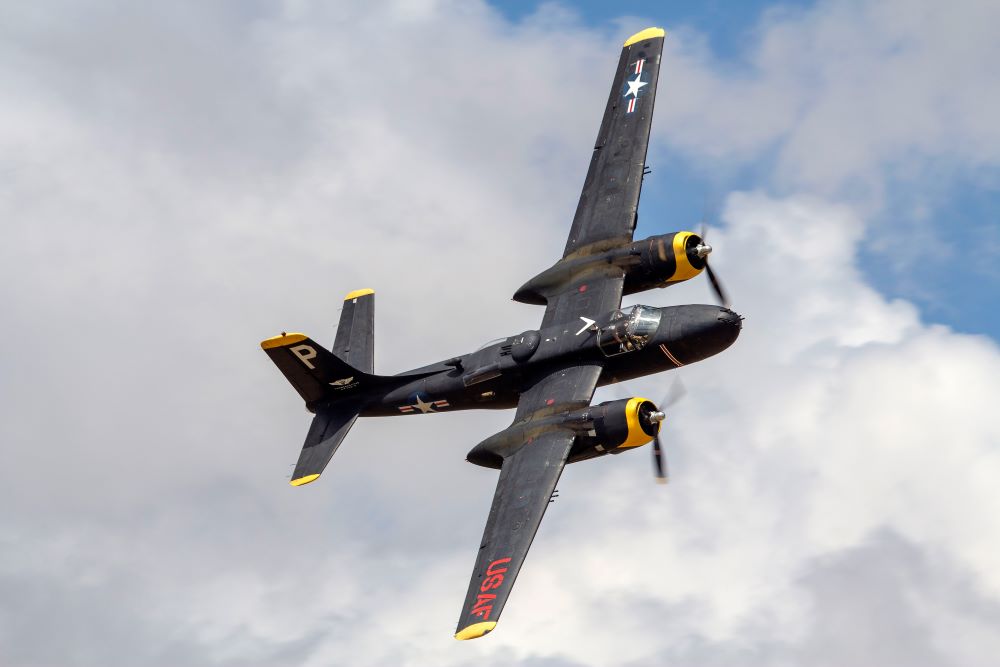
A-26B SN# 43-7140 was built in 1943 it was the 328th A26B built at the Douglas plant in Long Beach, Calif. It was delivered to the USAAF on December 8, 1944 and given the USAAF serial number of 41-39427. It served with the following military units listed below:
- 127th base unit at Florence S.C. – January 4, 1944 through November 13, 1945
- 4160th base unit Air Material Command at Hobbs Field N.M. – November 13, 1945 through September 1948
- 4127th base unit Air Material Command at McLellan AFB in CA – September 1948 to March 13, 1950
On March 13, 1950, the aircraft was stricken from the USAF inventory and sold on the civilian market. The aircraft spent 2 years in storage until Alex Oser, a scrap dealer bought it and 13 other A26’s in January of 1952. On March 19, 1952, the aircraft was sold to Texas Railway Equipment Co. of Houston; this aircraft being one of nine sold to this company. Later, seven of the aircraft ended up going to the French Air Force.
The aircraft went through major modifications in April of 1953 when the aircraft was completely disassembled and all systems inspected and repaired or overhauled. It was at this time the aircraft was converted to an executive transport with many luxuries and modifications being done to the aircraft by Grand Central Aircraft Co. of Glendale, California.
Info from the Commemorative Air Force
Photo by: Kevin Hong and Sector K Media
Volar P-38 Lightning 2/3 scale
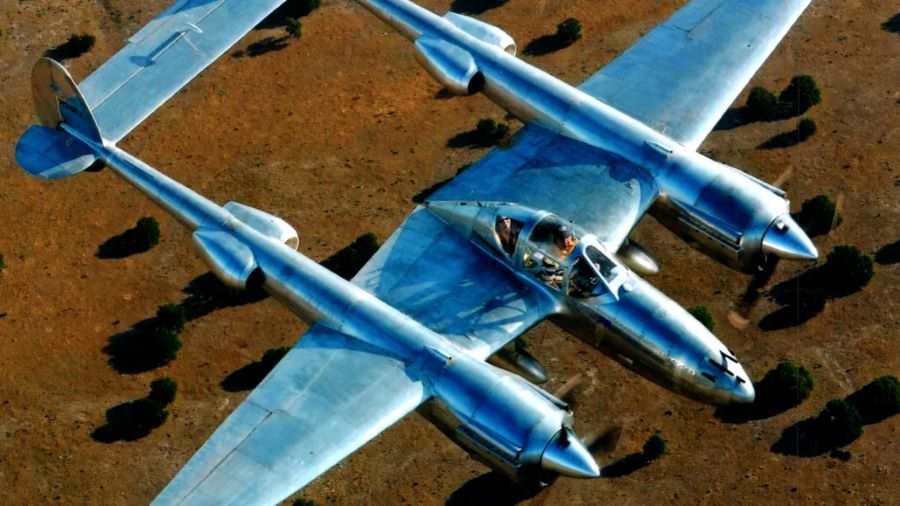
One of our most favorite things about Airshows is seeing dreams come to life. Whether it’s a child who becomes inspired to fly because they attended an airshow, a pilot who is flying because they chased their dreams of flight, or a passion project with deep meaning, these stories (and many more) are why we love what we do.
This is a story of that caliber. Inspiring to say the least.
For more info, check out this video: https://youtu.be/UC7VkgglMsE

RAVN L-39ZA/C Albatros
en.wikipedia.org/wiki/Ravn_Aerospace
Ravn Aerospace, formerly known as AirUSA, is an American defense contractor based at Houston Spaceport in Houston, Texas. It offers adversary air, close air support, Joint Terminal Attack Controller, and Intelligence, Surveillance, and Reconnaissance training to the United States Department of Defense.
Ravn Aero’s first aircraft, a Czech Aero L-39 Albatros, was purchased in 1994. Then, two years later, the company purchased two Mikoyan MiG-29s from Kyrgyzstan. In 2019, AirUSA was one of seven companies awarded an IDIQ contract to support the United States Air Force’s Combat Air Force Contract Air Support (CAF CAS) program in October 2019.
They will have two L-39ZA/C’s both flying and on display for you!

Grumman F8F Bearcat
en.wikipedia.org/wiki/Grumman_F8F_Bearcat
The Grumman F8F Bearcat is an American single-engined, carrier-based fighter aircraft introduced in late World War II. It served during the mid-20th century in the United States Navy, the United States Marine Corps, and the air forces of other nations. It was Grumman Aircraft’s last piston-engined fighter aircraft. Adapted versions of the Bearcat have broken speed records for piston-engined aircraft. Today, the Bearcat is popular among warbird owners and air racers.

CAF Gulf Coast Wing SNJ T-6 and Navy JRB Expeditor
The Gulf Coast Wing of the Commemorative Air Force operates and maintains a Navy JRB-6 Twin Beech “Little Raider”, and a Navy SNJ-5 Texan. These aircraft are flown to airshows and other events all over the USA as outreach for the Living History Experience programs of the Commemorative Air Force.
At the end of each airshow day warbird fans can take a flight aboard one of our vintage aircraft.
Those who wish to fly can reserve on line below or call 855-359-2217 to book a flight.
T-6A Texan II
www.af.mil/About-Us/Fact-Sheets/Display/Article/104548/t-6a-texan-ii/
Mission
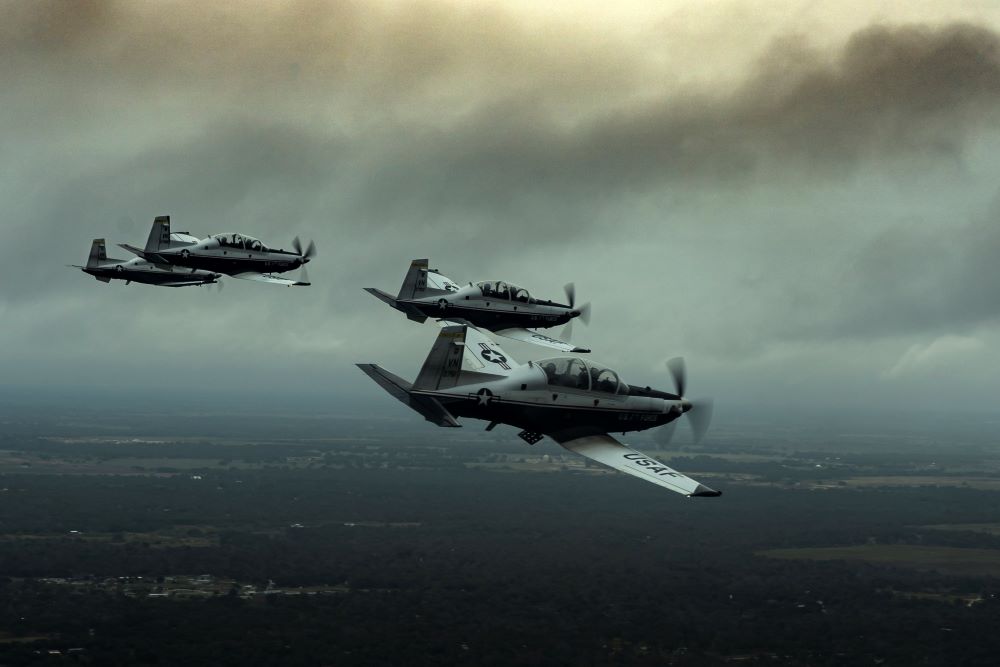
The T-6A Texan II is a single-engine, two-seat primary trainer designed to train Joint Primary Pilot Training, or JPPT, students in basic flying skills common to U.S. Air Force and Navy pilots.
Features
Produced by Raytheon Aircraft, the T-6A Texan II is a military trainer version of Raytheon’s Beech/Pilatus PC-9 Mk II.
Stepped-tandem seating in the single cockpit places one crewmember in front of the other, with the student and instructor positions being interchangeable. A pilot may also fly the aircraft alone from the front seat. Pilots enter the T-6A cockpit through a side-opening, one-piece canopy that has demonstrated resistance to bird strikes at speeds up to 270 knots.
The T-6A has a Pratt & Whitney Canada PT6A-68 turbo-prop engine that delivers 1,100 horsepower. Because of its excellent thrust-to-weight ratio, the aircraft can perform an initial climb of 3,100 feet (944.8 meters) per minute and can reach 18,000 feet (5,486.4 meters) in less than six minutes.
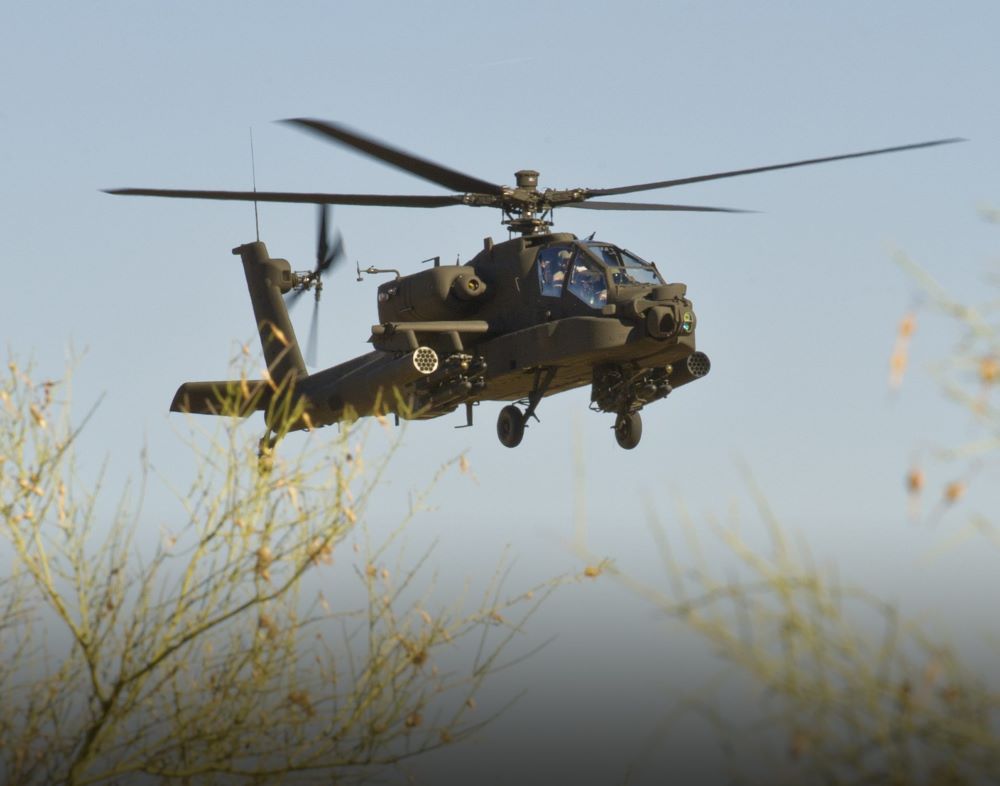
U.S. Army's AH-64D/E Apache Attack Helicopter
asc.army.mil/web/portfolio-item/apache-attack-helicopter-ah-64d-e/
The Apache AH-64D/E is the Army’s attack helicopter. It is capable of destroying armor, personnel, and materiel targets in obscured battlefield conditions. The Apache is a twin-engine, four-blade tandem-seat attack helicopter equipped with an M230 30-mm cannon, Hydra-70 2.75-inch rockets, and HELLFIRE missiles (both laser-guided and radio frequency). The current Army Aviation fleet contains both AH-64D Longbow Apaches and AH-64E models. The Apache is fielded to both Active Army and Army National Guard armed reconnaissance battalions and cavalry units. The aircraft is designed to support Brigade Combat Teams across the full spectrum of warfare.
The Apache provides security to ground forces, fixed based operations, and aerial escorts; conducts reconnaissance to provide situational awareness to ground forces and higher headquarters; and decisively engages single or multiple enemy combatants to allow freedom of maneuver or protection. It maneuvers into enemy territory to conduct deep attacks on strategic targets to set the conditions for favorable ground commander operations. With the Manned-Unmanned Teaming capability, the AH-64 can send real-time situational awareness of the environment and enemy forces to Soldiers in contact.

CH-46 Sea Knights
The Sea Knight was operated by the USMC to provide all-weather, day-or-night assault transport of combat troops, supplies and equipment until it was replaced by the MV-22 Osprey during the 2010s. The USMC also used the helicopter for combat support, search and rescue (SAR), casualty evacuation and Tactical Recovery of Aircraft and Personnel (TRAP). The Sea Knight also functioned as the US Navy’s standard medium-lift utility helicopter prior to the type being phased out of service in favor of the MH-60S Knighthawk during the early 2000s.
Photo from: National U.S. Armed Forces Museum
Info: https://en.wikipedia.org/wiki/Boeing_Vertol_CH-46_Sea_Knight
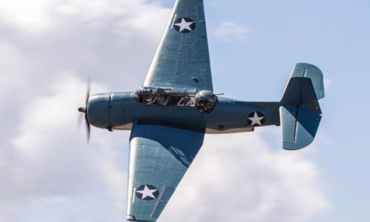
TBM-3E Avenger
lonestarflight.org/fly/general-motors-tbm-3e-avenger/
The Avenger was the largest single engine aircraft of WWII. Avengers first saw combat during the Battle of Midway in June 1942 and quickly equipped every U.S. Navy carrier operating in World War II, as well as many carriers of the British Royal Navy. Because Grumman was being pushed to produce F6F Hellcat fighters, production of the Avenger was turned over to General Motors’ Eastern Aircraft Division which built 7,546 aircraft under the designation TBM. These aircraft would go on to drop more tonnage in bombs and torpedoes than any other naval aircraft and would sink dozens of enemy ships including the Japanese super-battleships Yamato and Musashi. TBMs also accounted for 30 German and Japanese submarines as well as 98 enemy aircraft in air-to-air combat.
The key to the Avenger’s success was its versatility. In addition to its role as a torpedo bomber, TBMs were used for dive bombing, level bombing, night attack, photo reconnaissance, anti-submarine warfare, radar surveillance and light transport duties. Nicknamed the “turkey” for their slow lumbering movement and large ungainly appearance while coming in to land, the Avenger served into the mid-1950s and were supplied to allied nations such as Canada, France, England, Brazil, Japan, the Netherlands, New Zealand and Uruguay.
Info: Lone Star Flight Museum
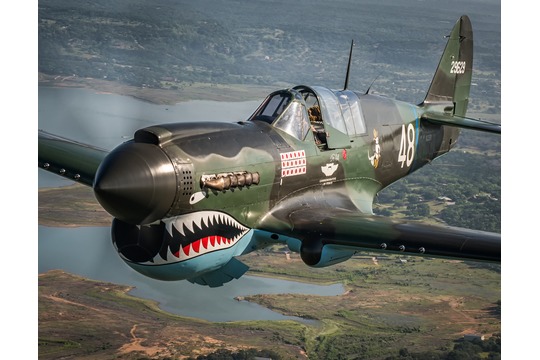
P-40 Warhawk
commemorativeairforce.org/aircraft/20
The Curtiss P-40 Warhawk is an American single-engined, single-seat, all-metal fighter and ground-attack aircraft that first flew in 1938. The P-40 design was a modification of the previous Curtiss P-36 Hawk which reduced development time and enabled a rapid entry into production and operational service. The Warhawk was used by most Allied powers during World War II, and remained in frontline service until the end of the war. It was the third most-produced American fighter, after the P-51 and P-47; by November 1944, when production of the P-40 ceased, 13,738 had been built,[4] all at Curtiss-Wright Corporation’s main production facilities at Buffalo, New York.
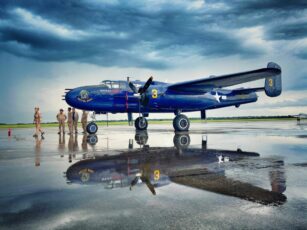
B-25 "Devil Dog"
The Devil Dog represents a PBJ-1J (the second J designates the model) of the VMB 612 squadron.
The Marines designated the B-25s “PBJ”. PB indicates Patrol Bomber and the J is an alpha-code designating the manufacturer, North American Aviation (PBJ does not mean Peanut Butter and Jelly).
The Marines were innovative in customizing the PBJs for the jobs they faced. As most of the missions were performed at low altitude, there was not much need for the glass nose/bombardier position. It was replaced with a solid nose and armed with up to 8 – .50 caliber machine guns, or in some versions, a 75mm cannon.
9 PBJ squadrons made it overseas before the war ended in the Pacific. 26 PBJs were lost in combat and 19 were lost in operational accidents while in a combat zone.
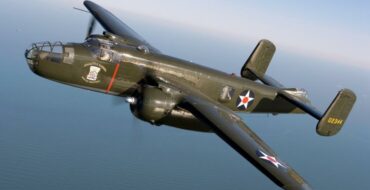
B-25 Mitchell "Doolittle Raiders" edition from Lone Star Flight Museum
lonestarflight.org/fly/north-american-b-25-mitchell/
The LSFM B-25 remained stateside during World War II and was converted into a trainer after the war for the USAF where it flew until the late 1950s. Acquired by the CIA, it flew covert missions during the Bay of Pigs invasion from Central America. Later, it would pass through several owners and was eventually restored in the late 1970s. LSFM founder Robert L. Waltrip purchased the B-25 in 1984 as the first of his collection that would serve as the basis for the Lone Star Flight Museum. Known as Special Delivery for many years, the LSFM repainted the airplane in 2007 in the colors of the Doolittle Raiders. It is the only flying B-25 painted in the colors of the Raiders and is the only civilian aircraft to feature the Doolittle Raider emblem. It is the official B-25 of the Doolittle Raider Association.
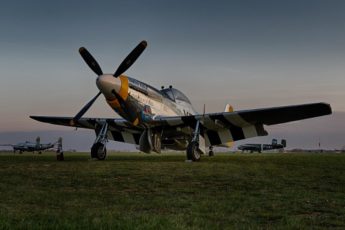
P-51 Mustang
“The North American Aviation P-51 Mustang is an American long-range, single-seat fighter and fighter-bomber used during World War II, the Korean War and other conflicts. The Mustang was designed in 1940 by North American Aviation (NAA) in response to a requirement of the British Purchasing Commission for license-built Curtiss P-40 fighters. The prototype NA-73X airframe was rolled out on 9 September 1940, 102 days after the contract was signed and first flew on 26 October.
The Mustang was originally designed to use the Allison V-1710 engine, which, in its earlier variants, had limited high-altitude performance. It was first flown operationally by the Royal Air Force (RAF) as a tactical-reconnaissance aircraft and fighter-bomber (Mustang Mk I). The addition of the Rolls-Royce Merlin to the P-51B/C model transformed the Mustang’s performance at altitudes above 15,000 ft, matching or bettering that of the Luftwaffe’s fighters. The definitive version, the P-51D, was powered by the Packard V-1650-7, a license-built version of the Rolls-Royce Merlin 66 two-stage two-speed supercharged engine, and was armed with six .50 caliber (12.7 mm) M2/AN Browning machine guns.
From late 1943, P-51Bs (supplemented by P-51Ds from mid-1944) were used by the USAAF’s Eighth Air Force to escort bombers in raids over Germany, while the RAF’s 2 TAF and the USAAF’s Ninth Air Force used the Merlin-powered Mustangs as fighter-bombers, roles in which the Mustang helped ensure Allied air superiority in 1944.[10] The P-51 was also used by Allied air forces in the North African, Mediterranean and Italian theaters, and also served against the Japanese in the Pacific War. During World War II, Mustang pilots claimed 4,950 enemy aircraft shot down.
At the start of the Korean War, the Mustang was the main fighter of the United Nations until jet fighters such as the F-86 took over this role; the Mustang then became a specialized fighter-bomber. Despite the advent of jet fighters, the Mustang remained in service with some air forces until the early 1980s. After World War II and the Korean War, many Mustangs were converted for civilian use, especially air racing, and increasingly, preserved and flown as historic warbird aircraft at airshows.”
Credit/Source:
https://en.wikipedia.org/wiki/North_American_P-51_Mustang
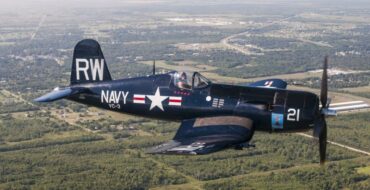
F4U-5N Corsair
lonestarflight.org/fly/chance-vought-f4u-5n-corsair/
“The Vought F4U Corsair is an American fighter aircraft that saw service primarily in World War II and the Korean War. Demand for the aircraft soon overwhelmed Vought’s manufacturing capability, resulting in production by Goodyear and Brewster: Goodyear-built Corsairs were designated FG and Brewster-built aircraft F3A. From the first prototype delivery to the U.S. Navy in 1940, to final delivery in 1953 to the French, 12,571 F4U Corsairs were manufactured, in 16 separate models, in the longest production run of any piston-engined fighter in U.S. history (1942–53).
The Corsair was designed as a carrier-based aircraft but its difficult carrier landing performance rendered it unsuitable for Navy use until the carrier landing issues were overcome by the British Fleet Air Arm. The Corsair thus came to and retained prominence in its area of greatest deployment: land based use by the U.S. Marines. The role of the dominant U.S. carrier based fighter in the second part of the war was thus filled by the Grumman F6F Hellcat, powered by the same Double Wasp engine first flown on the Corsair’s first prototype in 1940. The Corsair served to a lesser degree in the U.S. Navy. As well as the U.S. and British use the Corsair was also used by the Royal New Zealand Air Force, the French Navy Aéronavale and other, smaller, air forces until the 1960s. Some Japanese pilots regarded it as the most formidable American fighter of World War II, and the U.S. Navy counted an 11:1 kill ratio with the F4U Corsair.”
Source/Link:
https://en.wikipedia.org/wiki/Vought_F4U_Corsair
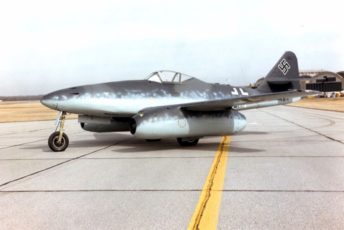
Messerschmitt Me 262 "Swallow"
“The Messerschmitt Me 262, nicknamed Schwalbe (German: “Swallow”) in fighter versions, or Sturmvogel (German: “Storm Bird”) in fighter-bomber versions, was the world’s first operational jet-powered fighter aircraft. Design work started before World War II began, but engine problems, metallurgical problems and top-level interference kept the aircraft from operational status with the Luftwaffe until mid-1944. The Me 262 was faster, and more heavily armed than any Allied fighter, including the British jet-powered Gloster Meteor. One of the most advanced aviation designs in operational use during World War II, the Me 262 was used roles including light bomber, reconnaissance and experimental night fighter versions.
Me 262 pilots claimed a total of 542 Allied kills, although higher claims are sometimes made.The Allies countered its potential effectiveness in the air by attacking the aircraft on the ground and during takeoff and landing. Engine reliability problems, from the pioneering nature of its Junkers Jumo 004 axial-flow turbojet engines—the first ever placed in mass production—and attacks by Allied forces on fuel supplies during the deteriorating late-war situation also reduced the effectiveness of the aircraft as a fighting force. In the end, the Me 262 had a negligible impact on the course of the war as a result of its late introduction and the consequently small numbers put in operational service.
While German use of the aircraft ended with the close of the Second World War, a small number were operated by the Czechoslovak Air Force until 1951. Captured Me 262s were studied and flight tested by the major powers, and ultimately influenced the designs of a number of post-war aircraft such as the North American F-86 Sabre and Boeing B-47 Stratojet. A number of aircraft have survived on static display in museums, and there have also been several privately built flying reproductions.”
Source/Link:
https://en.wikipedia.org/wiki/Messerschmitt_Me_262
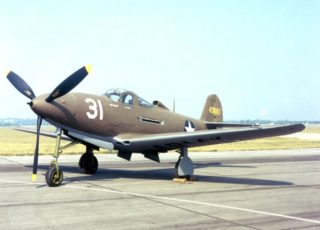
P-39 Aircobra
“The Bell P-39 Airacobra was one of the principal American fighter aircraft in service when the United States entered World War II. The P-39 was used with great success by the Soviet Air Force, which scored the highest number of individual kills attributed to any U.S. fighter type. Other major users of the type included the Free French, the Royal Air Force, the United States Army Air Forces, and the Italian Co-Belligerent Air Force.”
Credit/Source:
https://en.wikipedia.org/wiki/Bell_P-39_Airacobra
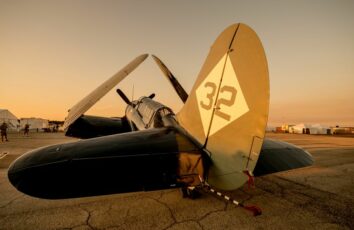
SB2C Helldiver
“The Curtiss SB2C Helldiver was a carrier-based dive bomber aircraft produced for the United States Navy during World War II. It replaced the Douglas SBD Dauntless in US Navy service. The SB2C was much faster than the SBD it replaced.
Crew nicknames for the aircraft included the Big-Tailed Beast (or just the derogatory Beast), Two-Cee and Son-of-a-Bitch 2nd Class (after its designation and partly because of its reputation for having difficult handling characteristics). Neither pilots nor aircraft carrier captains seemed to like it.
Delays marred its production—by the time the A-25 Shrike variant for the USAAF was deployed in late 1943, the Army Air Forces no longer had a need for a thoroughbred dive bomber. Poor handling of the aircraft was another factor that hampered its service introductions; both the British Royal Navy and the Royal Australian Air Force cancelled substantial orders.
The Truman Committee investigated Helldiver production and turned in a scathing report, which eventually led to the beginning of the end for Curtiss. Problems with the Helldiver were eventually ironed out, and in spite of its early problems, the aircraft was flown through the last two years of the Pacific War with a fine combat record.”
Credit/Source:
https://en.wikipedia.org/wiki/Curtiss_SB2C_Helldiver

A-1D Skyraider
“The Douglas A-1 Skyraider (formerly AD) is an American single-seat attack aircraft that saw service between the late 1940s and early 1980s. The Skyraider had a remarkably long and successful career; it became a piston-powered, propeller-driven anachronism in the jet age, and was nicknamed “Spad”, after the French World War I fighter.
It was operated by the United States Navy (USN), the United States Marine Corps (USMC) and the United States Air Force (USAF), and also saw service with the British Royal Navy, the French Air Force, the Air Force of the Republic of Vietnam (VNAF), and others. In U.S. service, it was finally replaced by the LTV A-7 Corsair II swept wing subsonic jet in the early 1970s.”
Credit/Source:
https://en.wikipedia.org/wiki/Douglas_A-1_Skyraider
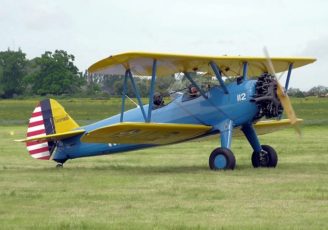
PT-17 Stearman
“The Stearman (Boeing) Model 75 is a biplane used as a military trainer aircraft, of which at least 10,626 were built in the United States during the 1930s and 1940s.[1] Stearman Aircraft became a subsidiary of Boeing in 1934. Widely known as the Stearman, Boeing Stearman or Kaydet, it served as a primary trainer for the United States Army Air Forces, the United States Navy (as the NS & N2S), and with the Royal Canadian Air Force as the Kaydet throughout World War II. After the conflict was over, thousands of surplus aircraft were sold on the civilian market. In the immediate postwar years they became popular as crop dusters, sports planes, and for aerobatic and wing walking use in air shows.”
Credit/Source:
https://en.wikipedia.org/wiki/Boeing-Stearman_Model_75
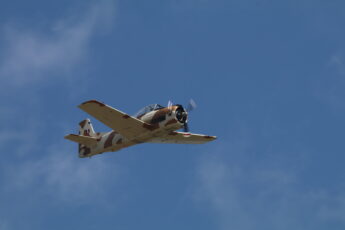
T-28 Trojan
The North American Aviation T-28 Trojan is a piston-engined military trainer aircraft used by the United States Air Force and United States Navy beginning in the 1950s. Besides its use as a trainer, the T-28 was successfully employed as a counter-insurgency aircraft, primarily during the Vietnam War. It has continued in civilian use as an aerobatics and Warbird performer.
Source/Credit:
https://en.wikipedia.org/wiki/North_American_T-28_Trojan
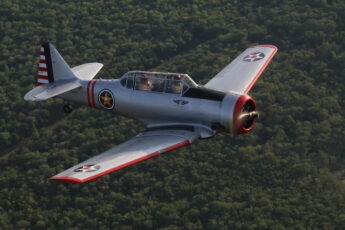
T-6 Texan
“The North American Aviation T-6 Texan is a single-engined advanced trainer aircraft used to train pilots of the United States Army Air Forces (USAAF), United States Navy, Royal Air Force, and other air forces of the British Commonwealth during World War II and into the 1970s. Designed by North American Aviation, the T-6 is known by a variety of designations depending on the model and operating air force. The United States Army Air Corps (USAAC) and USAAF designated it as the AT-6, the United States Navy the SNJ, and British Commonwealth air forces, the Harvard, the name by which it is best known outside of the US. After 1962, US forces designated it the T-6. It remains a popular warbird aircraft used for airshow demonstrations and static displays. It has also been used many times to simulate various Japanese aircraft, including the Mitsubishi A6M Zero in movies depicting World War II in the Pacific.”
Source/Credit:
https://en.wikipedia.org/wiki/North_American_T-6_Texan
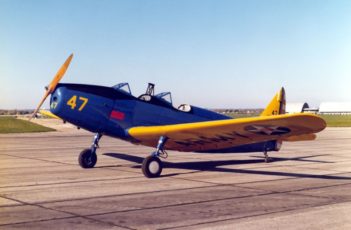
Fairchild PT-19
“The Fairchild PT-19 (company designation Fairchild M62) is an American Fairchild Aircraft monoplane primary trainer aircraft that served with the United States Army Air Forces, RAF and RCAF during World War II. It was a contemporary of the Kaydet biplane trainer and was used by the USAAF during Primary Flying Training as the introductory pre-solo phase trainer for introducing new pilots to flying before passing them on to the more agile Kaydet. As with other USAAF trainers of the period, the PT-19 had multiple designations based on the powerplant installed.”
Source/Credit:
https://en.wikipedia.org/wiki/Fairchild_PT-19
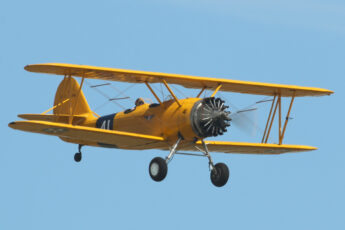
Naval Aircraft Factory N3N
The Naval Aircraft Factory N3N was an American tandem-seat, open cockpit, primary training biplane aircraft built by the Naval Aircraft Factory (NAF) in Philadelphia, Pennsylvania, during the 1930s.
Source/Credit:
https://en.wikipedia.org/wiki/Naval_Aircraft_Factory_N3N
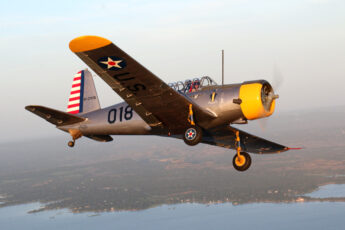
BT-13 Valiant
The Vultee BT-13 Valiant was an American World War II-era basic trainer aircraft built by Vultee Aircraft for the United States Army Air Corps, and later US Army Air Forces. A subsequent variant of the BT-13 in USAAC/USAAF service was known as the BT-15 Valiant, while an identical version for the US Navy was known as the SNV and was used to train naval aviators for the US Navy and its sister services, the US Marine Corps and US Coast Guard.
Source/Credit:
https://en.wikipedia.org/wiki/Vultee_BT-13_Valiant
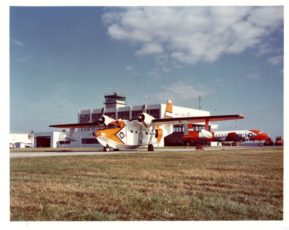
HU-16 Albatross
The Grumman HU-16 Albatross is a large twin–radial engine amphibious flying boat that was used by the United States Air Force (USAF), the U.S. Navy (USN) and the U.S. Coast Guard (USCG), primarily as a search and rescue aircraft. Originally designated as the SA-16 for the USAF and the JR2F-1 and UF-1 for the USN and USCG, it was redesignated as the HU-16 in 1962.
Source/Credit:
https://en.wikipedia.org/wiki/Grumman_HU-16_Albatross
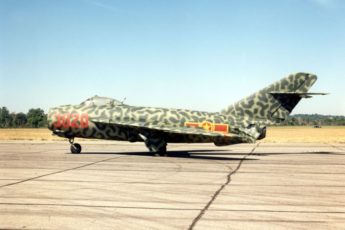
MiG-17 Fresco
“The Mikoyan-Gurevich MiG-17 (Russian: Микоян и Гуревич МиГ-17) (NATO reporting name: Fresco) (China:Shenyang J-5) (Poland: PZL-Mielec Lim-5)[1] is a high-subsonic fighter aircraft produced in the USSR from 1952 and operated by numerous air forces in many variants. It is an advanced development of the very similar appearing MiG-15 of the Korean War.
The MiG-17 first saw combat in 1958 over the Straits of Taiwan and was used as an effective threat against supersonic fighters of the United States in the Vietnam War. It was also briefly known as the Type 38, by U.S. Air Force designation prior to the development of NATO codes.
Source/Credit:
https://en.wikipedia.org/wiki/Mikoyan-Gurevich_MiG-17
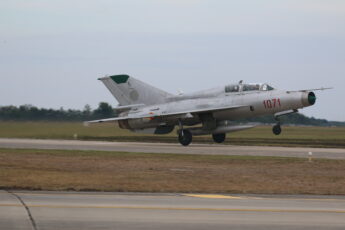
MiG-21 Fishbed
“The Mikoyan-Gurevich MiG-21 (Russian: Микоян и Гуревич МиГ-21; NATO reporting name: Fishbed) is a supersonic jet fighter aircraft, designed by the Mikoyan-Gurevich Design Bureau in the Soviet Union. It was popularly nicknamed “Balalaika”, from the aircraft’s planform-view resemblance to the Russian stringed musical instrument or ołówek (English: pencil) by Polish pilots due to the shape of its fuselage.
Early versions are considered second-generation jet fighters, while later versions are considered to be third-generation jet fighters.[citation needed] Approximately 60 countries over four continents have flown the MiG-21, and it still serves many nations six decades after its maiden flight. The fighter made aviation records. At least by name, it is the most-produced supersonic jet aircraft in aviation history and the most-produced combat aircraft since the Korean War, and it was previously the longest production run of a combat aircraft (now exceeded by both the McDonnell Douglas F-15 Eagle and General Dynamics F-16 Fighting Falcon).”
Credit:
https://en.wikipedia.org/wiki/Mikoyan-Gurevich_MiG-21
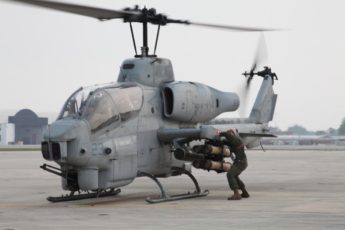
AH-1 Cobra
“The Bell AH-1 Cobra is a two-blade, single engine attack helicopter manufactured by Bell Helicopter. It was developed using the engine, transmission and rotor system of the Bell UH-1 Iroquois. A member of the prolific Huey family, the AH-1 is also referred to as the HueyCobra or Snake.
The AH-1 was the backbone of the United States Army’s attack helicopter fleet, but has been replaced by the AH-64 Apache in Army service. Upgraded versions continue to fly with the militaries of several other nations. The AH-1 twin engine versions remain in service with United States Marine Corps (USMC) as the service’s primary attack helicopter. Surplus AH-1 helicopters have been converted for fighting forest fires.”
Credit:
https://en.wikipedia.org/wiki/Bell_AH-1_Cobra
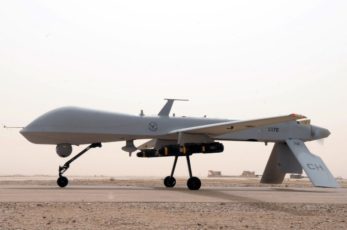
MQ-1 Predator
The General Atomics MQ-1 Predator is an American remotely piloted aerial vehicle (RPA) built by General Atomics and used primarily by the United States Air Force (USAF) and Central Intelligence Agency (CIA). Initially conceived in the early 1990s for aerial reconnaissance and forward observation roles, the Predator carries cameras and other sensors but has been modified and upgraded to carry and fire two AGM-114 Hellfire missiles or other munitions. The aircraft, in use since 1995, has seen combat in war in Afghanistan, Pakistan, the NATO intervention in Bosnia, Serbia, Iraq War, Yemen, Libyan civil war, the intervention in Syria, and Somalia.
The USAF describes the Predator as a “Tier II” MALE UAS (medium-altitude, long-endurance unmanned aircraft system). The UAS consists of four aircraft or “air vehicles” with sensors, a ground control station (GCS), and a primary satellite link communication suite.Powered by a Rotax engine and driven by a propeller, the air vehicle can fly up to 400 nmi (460 mi; 740 km) to a target, loiter overhead for 14 hours, then return to its base.
Credit/Source:
https://en.wikipedia.org/wiki/General_Atomics_MQ-1_Predator